Women’s Empowerment in Health
Trusting the Body Again
2/16/20263 min read
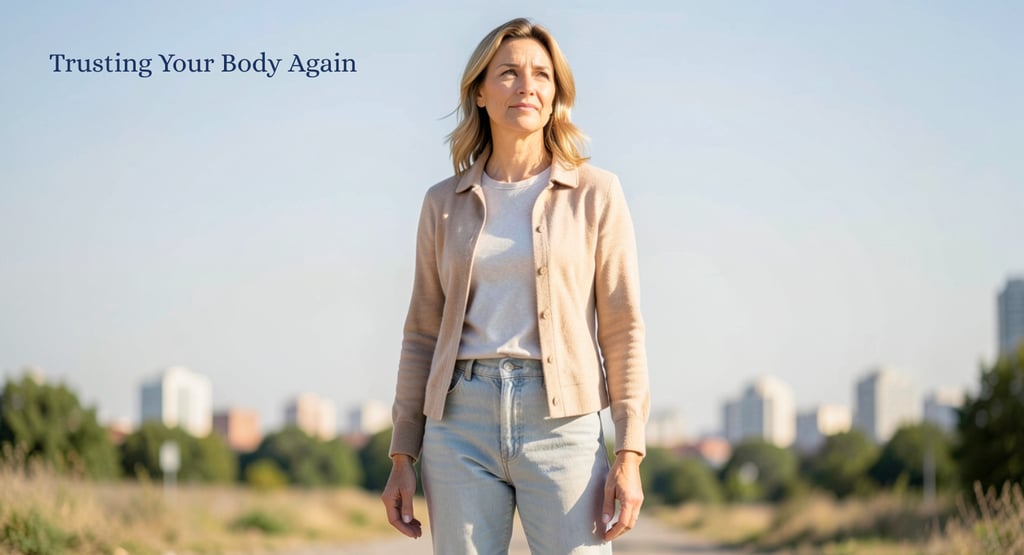
Women’s empowerment in health is often framed as doing more — more discipline, more information, more effort. In reality, empowerment usually begins with doing something much simpler: learning to trust the body again.
For many women, the relationship with their body has been shaped by years of external expectations. Pushing through tiredness. Normalising pain. Ignoring stress. Treating exhaustion as a personal failure rather than a signal. Over time, this can create a disconnect where the body feels unpredictable or unreliable instead of something to work with.
True empowerment in health does not come from trying harder. It comes from understanding the body, listening to its signals and responding with care.
When Women Learn Not to Listen
From a young age, many women are taught — often subtly — to put others first and keep going regardless of how they feel. This conditioning shows up physically. Hunger cues are ignored. Rest is delayed. Stress becomes background noise. Symptoms are minimised or brushed off as “just hormones” or “just part of life”.
Over time, this erodes trust. Fatigue becomes normal. Mood changes feel confusing. Energy fluctuates without explanation. Rather than seeing the body as a source of information, it can start to feel like something to manage, control or fix.
Rebuilding trust begins with recognising that these signals are not inconveniences. They are information.
The Role of Media and Social Expectations
This disconnection is reinforced by decades of messaging through magazines, advertising and, more recently, social media. Women are frequently shown images of bodies that appear effortless, lean and energised, often without context or realism.
The message is rarely explicit, but it is consistent: push harder, look better, be more disciplined.
Over time, this teaches women to prioritise appearance over function and external approval over internal cues. Hunger becomes something to suppress. Fatigue becomes something to override. Emotional shifts become something to correct.
Empowerment in health requires stepping away from these external measures and returning authority to the body itself. Health is not defined by an image. It is defined by how the body functions, adapts and feels over time.
Information Versus Empowerment
Women today have access to more health information than ever before, yet information alone does not equal empowerment. Conflicting advice around food, exercise and hormones can leave women feeling overwhelmed rather than confident.
Empowerment comes from understanding why something works, how it applies to individual circumstances and having permission to adapt advice rather than follow it rigidly. This is especially important during life stages such as pregnancy, postnatal recovery and midlife hormonal changes, where one-size-fits-all approaches often fall short.
Empowerment means being able to ask, “Does this support me right now?” — and trusting the answer.
Why the Nervous System Matters
One of the most overlooked aspects of women’s health is the nervous system. Many women live in a constant state of “push through”, juggling work, family responsibilities and emotional labour while running on stress hormones.
When the nervous system is under ongoing pressure, it affects sleep, digestion, hormones, mood and energy. Empowerment often begins not with doing more, but with learning how to slow down, regulate stress and create a sense of safety in the body.
When the nervous system feels more settled, the body becomes easier to work with rather than something to battle.
Food and Movement Without Rigid Rules
Empowered choices around food and movement are flexible, not rigid. They recognise that needs change depending on stress levels, seasons and life stages.
For many women, empowerment involves unlearning the idea that health requires constant discipline. Rest can be as supportive as exercise. Eating regularly can be more beneficial than restriction. Consistency matters more than perfection.
When food and movement are used as tools rather than rules, health becomes more sustainable and far less emotionally charged.
Midlife Changes and Shared Understanding
Midlife health changes, particularly during perimenopause, can be challenging not just for women but for their partners as well. Hormonal shifts can affect energy, mood, sleep and emotional resilience, often in ways that are invisible from the outside.
Without understanding what is happening physiologically, these changes can be misinterpreted as emotional or personal. This is one of the reasons I wrote the free mini book The Silent Shift. It was created to help partners understand what women are experiencing beneath the surface and how support, rather than solutions, makes a real difference.
The Silent Shift gives men language and context for these changes, helping reduce misunderstanding and pressure at a time when women need support most. The mini book can be downloaded from my website, wellnessyourway.coach.
Women’s empowerment in health is strengthened when understanding is shared and women feel supported rather than questioned during these transitions.
Small Steps That Build Trust
Empowerment does not require dramatic change. It grows through small, consistent actions — listening to energy levels, eating regularly, choosing movement that feels supportive and responding to stress earlier.
Over time, these small choices rebuild trust between a woman and her body. And when trust grows, confidence follows.
Women’s empowerment in health is not about control or perfection. It is about partnership — with the body, with knowledge and with choice. When women are supported to trust themselves, wellbeing becomes something that feels achievable, sustainable and aligned with real life.
Phone/WhatsApp
+64 21 020 29366
Waikato Contact
Hours
Tuesday to Saturday 9am to 6pm
Please get in touch to enquire about alternative timing
Professional Affiliations
Legal Information
At Wellness Your Way Ltd, we value transparency and integrity in all that we do. Our legal policies outline how we protect your privacy, manage your information and deliver services with care and professionalism.
Terms and Conditions: Explains how our services operate, including payments, cancellations, digital resources and client agreements.
Privacy Policy: Details how we collect, store and protect your personal information in accordance with New Zealand privacy standards.
Disclaimer: Clarifies that our wellness, nutrition and NLP coaching services are for educational and lifestyle purposes only and are not a substitute for medical care.
© 2025 Wellness Your Way Ltd. Wellness Your Way® and the Wellness Your Way logo are registered trademarks of Wellness Your Way Ltd. All rights reserved.
Victoria Kruse | Wellness Your Way Ltd
Health & Nutrition Coaching | NLP Coaching
New Zealand